
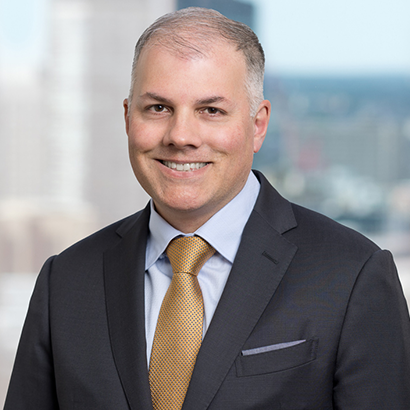
 On September 1, Mark Fleming started his term as president of the Boston Bar Association. He begins the story of how he got here somewhere far from the legal profession: with his family.
Fleming grew up outside of Montreal. His mother immigrated to Canada from India, and his father came from northern England. When Mark was born, his father was completing a Ph.D. in chemistry and later worked as a research scientist in Montreal. Fleming and his younger sister grew up in an English-speaking neighborhood while attending French-language schools.
“My parents taught me to think about the world as made up of lots of different people who spoke lots of different languages,” Fleming says. “It was worth traveling and going to see them and learning how to relate to them.”
That outlook shaped Fleming early. He studied languages, loved to travel, and became comfortable entering unfamiliar places and finding his way. It would serve him well as he left Canada, entered a profession no one in his family knew much about, and eventually made a home in Boston. It also informs the way he thinks about the BBA and the kind of community he hopes it can be for lawyers throughout the city.
Finding the Law
Fleming did not grow up expecting to become a lawyer, and he had little idea what a legal career actually looked like. As a child, he wanted to be an airline pilot because he loved flying. Later, he imagined working in foreign affairs, becoming an ambassador, or joining the United Nations.
His 11th-grade English teacher, Donna George, saw a possible connection among his interests. One day, she suggested international business law. “She was pretty close,” Fleming says. “There have been some times when I’ve been more international than I am now. But business law is what I do.”
George had recognized that Fleming’s interests in language, writing, public speaking, and argument might translate well into a legal career. At the University of King’s College in Halifax, Nova Scotia, he studied German language, literature, and philosophy, as well as English, and spent much of his time reading, writing, and thinking about how to make a persuasive argument. He briefly considered academia but ultimately wanted work that felt more practical. Law offered many of the things he already enjoyed, with the possibility of achieving tangible results for someone else.
College also introduced him to Rachel Renton, his future wife, when they were both cast in a student theater production (Fleming had participated in debate before deciding that student theater was considerably more fun). In 1992, the two performed in Money, Power, Murder, Lust, Revenge, and Marvelous Clothes, a sendup of soap operas in which Fleming played a villainous plastic surgeon, and Rachel played his nurse.
“It was a terrible piece of work,” he says, laughing. “But it was a hilarious production.”
They started dating and remained together after Fleming left Halifax for Harvard Law School. During Fleming’s third year, Rachel moved to Massachusetts and began teaching in Greater Boston. They married in 1998 after Fleming completed his first judicial clerkship and have now been together for more than three decades. Theater has remained part of their lives, too. Fleming says the two have returned to the stage together for a couple of productions over the years.
Law School and Boston
Harvard Law School was an adjustment. Fleming found himself surrounded by classmates who, in some cases, had been preparing for legal careers for years. Some had lawyers in their families and arrived already familiar with the American legal system.
“I’d never read the U.S. Constitution,” he says. “I knew nothing about this stuff. I was coming in cold.”
Fleming also had to learn to write like a lawyer after years spent studying literature and philosophy. The style of analysis and argument was different, but he adjusted. By his second year, Fleming had earned a place on the Harvard Law Review. He found close friends, continued performing through the Harvard Law School Drama Society, and became more comfortable in a place that had initially felt foreign.
Boston was becoming familiar, too. On weekends, Fleming would leave Cambridge to explore neighborhoods, visit museums, go to concerts, or simply walk around. When Rachel moved to Massachusetts, they explored together. By the time Fleming graduated, Boston had begun to feel like a place where they could stay.
A Career Takes Shape
When Fleming talks about the judges and lawyers who shaped his career, he returns often to people who gave him opportunities before he had much of a professional track record.
Judge Michael Boudin of the U.S. Court of Appeals for the First Circuit gave Fleming his first job after law school. Fleming was grateful for Judge Boudin taking a chance on someone who had never worked in the United States before. “It was a wonderful year,” he says. “It’s hard to beat that experience, particularly as a first job out of law school.”
Over the next several years, Fleming’s career took him into some of the areas that had interested him long before he became a lawyer. He returned to Canada to clerk for Justice John C. Major of the Supreme Court of Canada and later served as an associate legal officer in the Appeals Chamber of the International Criminal Tribunal for the former Yugoslavia.
He also earned a much sought after clerkship with Justice David Souter at the U.S. Supreme Court. Near the end of that clerkship, Fleming was still deciding what the next stage of his career would look like. Washington was an option. So was Boston. He continued to think about international work and wondered whether he should return to Canada or work overseas.
One day, he mentioned the uncertainty to Justice Souter, who suggested that they grab their lunches and talk. For about 45 minutes, the Justice shared his thoughts about how a young attorney should build a career. Fleming remembers one piece of advice in particular: Washington could be a valuable place for a lawyer to spend time, Justice Souter told him, but it was important to be from somewhere else.
“I don’t know what it was, but at that particular time, I was ready to receive that message,” Fleming says. “I never regretted heeding that advice, and I never missed an opportunity to thank him for it.”
Boston gave Fleming a way to take that advice without giving up the kind of practice he wanted. The 2004 merger that created WilmerHale made it possible to build an appellate practice that had traditionally been centered in Washington while living and working in Boston. “That’s been a terrific career choice because I get to do what I like in the city of my choice,” he says.
The city also gave Fleming and Rachel a place where they could raise a family. Their daughters are now in college, and the family still makes time to travel together, including a recent trip to Europe. Fleming says the balance Boston offers has remained part of its appeal.
At WilmerHale, Fleming found another group of mentors. He credits much of his development as a lawyer to Bill Lee, the firm’s former managing partner and a longtime leader of its intellectual property litigation practice, and Seth Waxman, the former U.S. Solicitor General who leads the firm’s appellate practice in Washington. “I learned just about everything that I do today either from one of them or from someone who was trained by them,” Fleming says.
One experience with Waxman has stayed with him. In 2011, Roche, the biotechnology company, had a case headed to the U.S. Supreme Court and expected Waxman to argue it. When Waxman became unavailable, he gave the client several options, including Fleming, then a young partner who had been writing the briefs but had never argued before the Court. Fleming learned about the conversation when the client called and told him he wanted Fleming to argue the case.
“As I was coming up through the ranks, I had people who took chances on me and gave me opportunities that they could have sent elsewhere,” Fleming says. He remembers what it meant for someone established to say he was ready before he had the experience that would make him an obvious choice, and he tries to give younger colleagues the same kind of opportunity.
Those mentors also shaped the way Fleming thinks about leadership when things go wrong. “Leadership is easy when things are going well, but it is most important when things are not going well,” he says.
Fleming recalled one occasion where he learned that something he had written in a brief turned out to be incorrect. He discussed the situation with Lee, who told him that figuring out the right thing to do was easy, but executing it was difficult. For Fleming, that meant informing the court and opposing counsel, explaining what happened, apologizing, and accepting the consequences.
“We made a mistake,” Fleming says. “We’re very sorry. Here’s what we should have said. And here’s the consequence.” He believes leadership in those moments also means taking responsibility.
“I’ve learned many lessons from Mark about advocacy, preparation, and confidence,” said Brittany Amadi, Partner at WilmerHale. “But most importantly, he taught me what great leadership looks like. Great mentors do not just open doors—they give people the confidence to walk through them.”
The qualities Fleming developed through those early opportunities have become hallmarks of his own practice.
“Mark Fleming is among our very few ‘go-to’ appellate counsel,” said Bryan Sinclair, Vice President & Deputy General Counsel, IP Litigation at Cisco Systems. “His breadth and depth of experience, ability to synthesize complex issues, and appellate advocacy skills are second to none.”
Finding the BBA
Fleming’s relationship with the BBA began with his interest in international law. Around 2001 or 2002, he attended a BBA program featuring the late Appeals Court Judge Gerry Gillerman, who discussed work he had done with the International Criminal Tribunal for Rwanda. Fleming approached him afterward, and the conversation grew into a friendship and opportunities to work together. Fleming says that relationship helped lead to his later work involving the Appeals Chamber of the international criminal tribunals.
A few years later, WilmerHale senior partner Richard A. Johnston encouraged him to become more formally involved with the BBA’s Litigation Section. Fleming was about seven or eight years into his career, and much of his appellate work was centered outside Massachusetts. Johnston’s advice was straightforward: lawyers at Fleming’s stage should become involved with the local bar, and WilmerHale had a long history of supporting the BBA.
Fleming took the advice, becoming involved with the Litigation Section and later serving on the Amicus Committee, Finance Committee, Nominating Committee, Council, and other parts of the organization. “If I’m asked to do something, as long as it sounds interesting, I’m likely to say yes,” he says.
“Mark’s leadership of the BBA feels like a natural extension of the role he has played throughout his career,” said Felicia Ellsworth, Partner in Charge of WilmerHale’s Boston office. “Having worked closely with Mark for many years and having been fortunate enough to call him a mentor myself, I have seen firsthand the impact he has had on colleagues, clients, and the broader legal community. The BBA could not have asked for a more thoughtful, dedicated, and effective leader.”
What kept Fleming involved in the BBA was less complicated: he liked the people. He has spent much of his career at a large firm where he has close friends, interesting work, and colleagues he enjoys, but he did not want WilmerHale to become his entire professional world. The BBA gave him a way to know lawyers outside his firm and become more connected to Boston’s legal community.
The organization has produced professional benefits along the way, including matters that came to Fleming through people he met at the BBA. But he says that was never the main reason he stayed involved. “I think the people who get involved in the organized bar tend to be very interesting and a lot of fun to be around,” he says.
Why the BBA Matters Now
Fleming is preparing to become BBA President at a time when he believes organized bar associations have an especially important role to play. That became personal after the federal government issued an executive order targeting WilmerHale. For Fleming, the response from the BBA and other bar associations demonstrated the value of lawyers being able to speak collectively about the independence of the profession and the rule of law.
The BBA publicly opposed efforts to punish lawyers because of the clients they represent or positions they take in court. Fleming saw that response as part of a broader responsibility for the organized bar to defend judges, democratic institutions, civil rights, and people in the community who may be particularly vulnerable. “I mean, talk about a benefit of membership,” he says. “It’s so, so valuable and so important right now.”
Fleming also wants the BBA to be a place where lawyers come together, meet people they might not otherwise know, and remember why their work matters. Lawyers can easily become consumed by their own matters, clients, deadlines, and responsibilities, he says, and lose sight of the larger role the profession plays in maintaining institutions that allow people to resolve disputes, protect their rights, conduct business, and live under a system in which government itself is subject to law.
He also wants people to enjoy being part of the BBA. His own experience with the organization has included serious work on legal issues, but also friendships, professional opportunities, and conversations that shaped his career. As he prepares to lead the organization, he hopes other lawyers will find some of the same things.
“I would love to help contribute to the feeling that, as lawyers, we are collectively a force for good,” he says.


