

The Breyer Learning Center: A Catalyst for Engagement in the Heart of the Courthouse
 By Allison Guenthner
A group of high school students huddles around a set of paper slips, deep in debate. Hands on hips, thoughtful back-and-forth, and well, what if questions fly as they sort through free‑speech–related scenarios—controversial talent‑show lyrics, a football team’s pregame protest, an online post that leads to a student’s suspension. “But what if a teacher posted that same tweet?” an adult asks, sparking another round of animated argument.
While the whiteboard, clustered desks, and lively discussion might suggest an ordinary classroom, this room actually sits on the upper floor of the John Joseph Moakley United States Courthouse. The learning activity, designed by civics educators and pushed into deeper legal analysis by law clerks, is just one step in a student’s experience at the Justice Stephen G. Breyer Community Learning Center on Courts and the Constitution (“the Breyer Learning Center” or the “Center”).
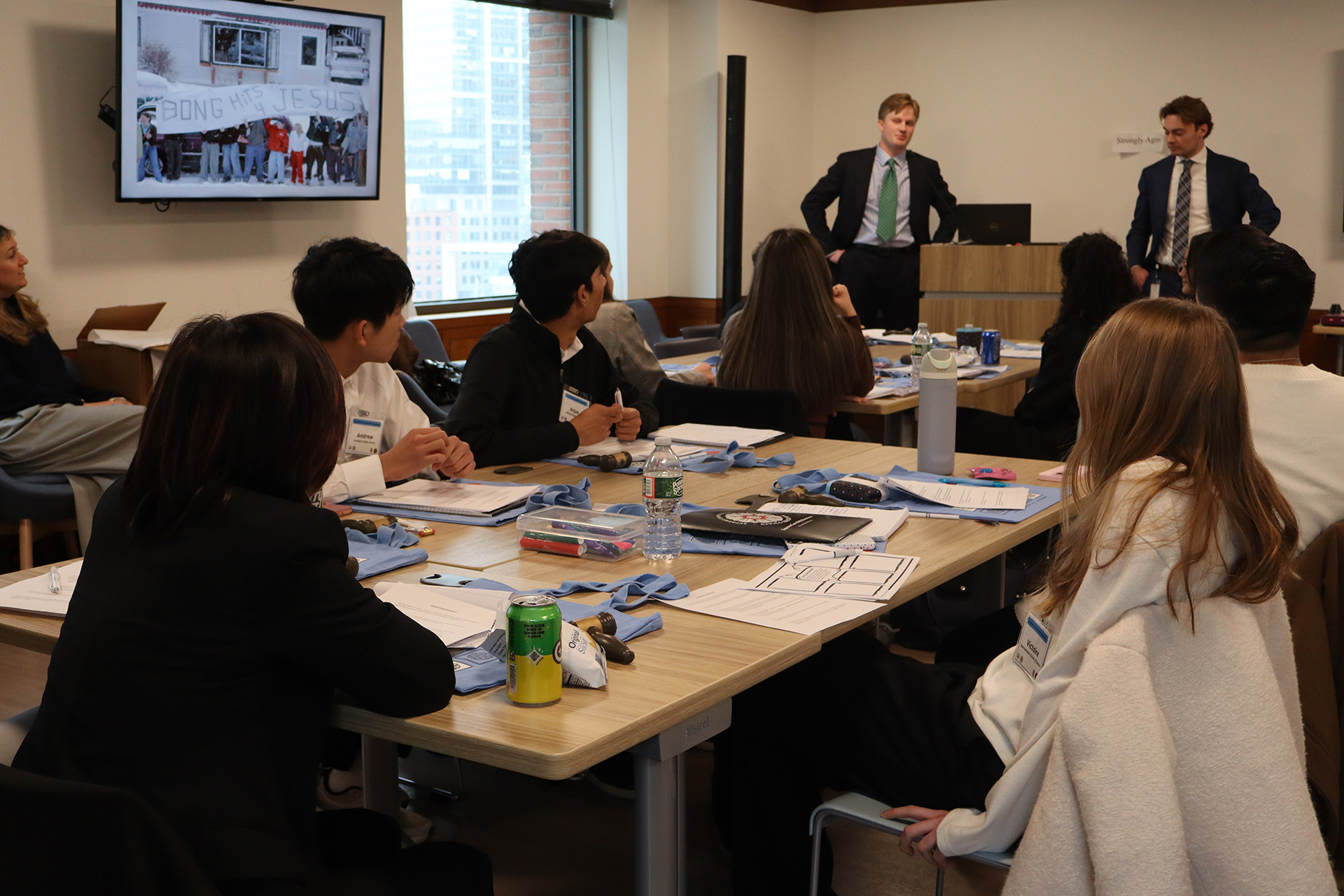
In the Center’s 1,000‑square‑foot, glass‑enclosed multipurpose training room—a space intentionally designed as a classroom—students begin by building familiarity with legal terminology, constitutional questions, and relevant case precedent. This preparation is part of a half‑day field trip conducted in partnership with the U.S. Court of Appeals for the First Circuit, the U.S. District Court for the District of Massachusetts, and Discovering Justice. The culminating experience of their visit is a courtroom simulation presided over by a federal judge. Under the arches and paneled walls of a federal courtroom, students are asked to apply the constitutional principles they have just studied to a fictional case. Supported by coaching from law clerks, they step to the podium one by one to present their arguments and field questions from student judges and, often, from an actual judge.
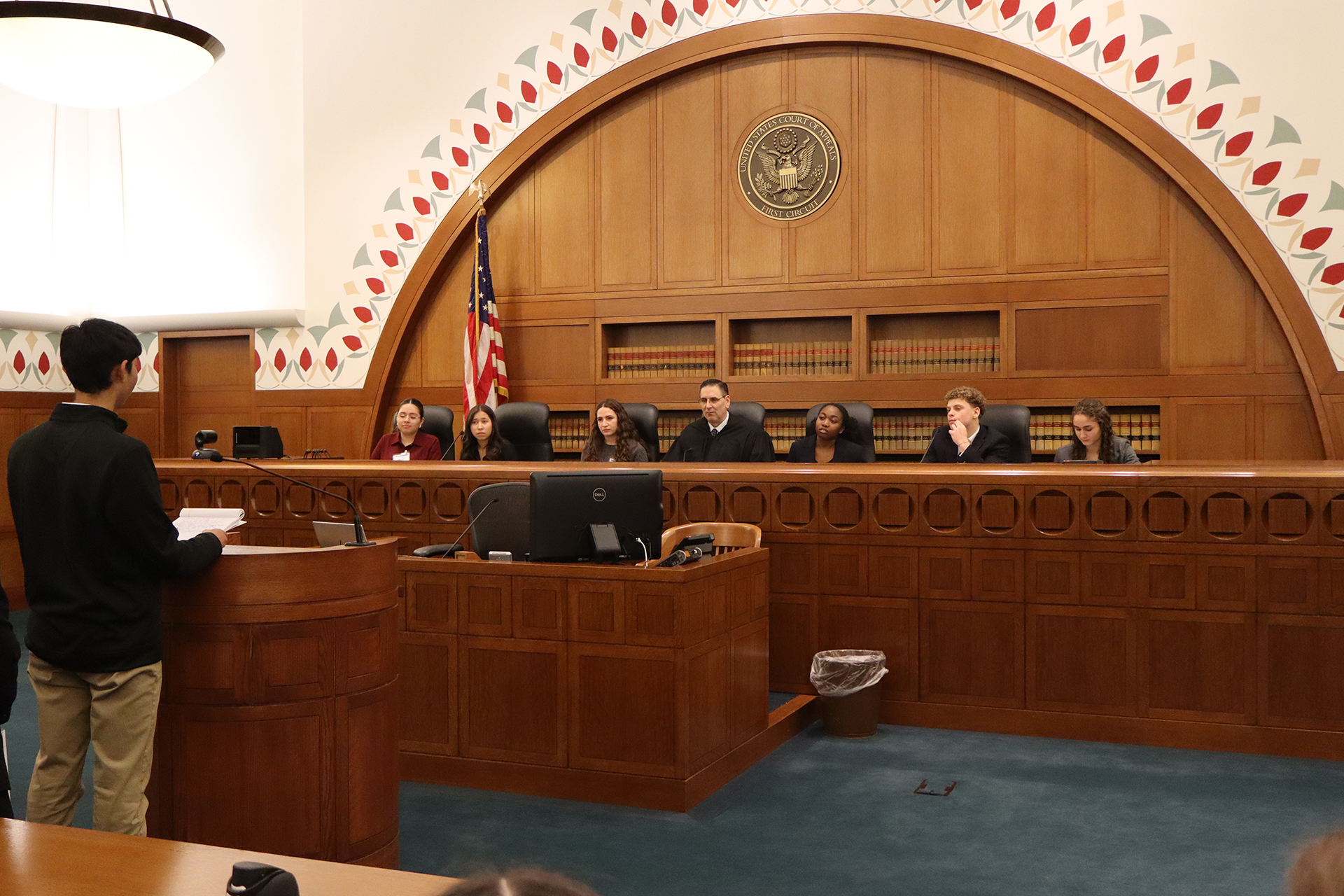
This is a look into the typical programming offered at the Breyer Learning Center—experiential learning grounded in research-based pedagogy, guided by legal experts, and designed to engage students as doers rather than observers. The Center, which opened in 2025, is a dedicated space for the public, especially teachers and students, to learn firsthand what the federal courts do and how they fit into the constitutional system. By pairing seasoned civics educators with mentorship from judges, clerks, and other legal professionals, the Center offers a range of programs mirroring the many ways people interact with the judiciary—from jury service to observing proceedings to advocacy—and invites each new generation into the ongoing American experiment of administering justice under the law.
For example, the Kennedy-Breyer Civic Scholars Program, run in partnership by the Breyer Learning Center, the John F. Kennedy Presidential Library and Museum, and the Edward M. Kennedy Institute for the United States Senate, provides 10th-grade students with a free summer experience to explore the interconnectedness of the three branches of government. Through hands-on activities and learning simulations, students trace the First Step Act through the legislative, executive, and judicial systems, traveling between each of the partner institutions throughout the program. While these experiences help students see the many ways they can participate in democracy, they also reveal something equally important: the democracy they study is carried out by real people every day.
Among the most surprising, and heartening, outcomes of the Breyer Learning Center’s civic engagement work has been the demystification of the people behind the court and the humanness of those who make our democracy work. Students have shared that “it is not just one person or group that is making decisions, there are so many people who have a say in things,” and that “even though some people may think the federal courts are not always fair, I learned that they really do try to make decisions based on justice and fairness.” For court staff, the opportunity to engage directly with the public has been especially meaningful, offering a chance to share the pride and conviction they bring to their work, particularly in a year that has placed extraordinary demands on federal employees.
Within the Moakley Courthouse community, mentorship has become a defining theme, one that shapes professional identity and builds confidence. Beyond providing exposure and understanding, the Center’s civic engagement work aims to create genuine pathways for young people across the ecosystem of the courts. Those pathways lead not only toward the legal profession but also toward the many essential roles that support the work of justice, from U.S. Probation and Pretrial Services to the U.S. Marshals Service.
This commitment to mentorship is part of a longer tradition within the judiciary and was vividly on display during the final day of The Supreme Court and My Hometown program. In this immersive program, Massachusetts high school students studied the federal judiciary through the lens of a Supreme Court case that originated in their “hometown.” After tracing the winding journey of Smith v. Goguen, 415 U.S. 566 (1974), a Vietnam War era flag‑desecration case, participants came to appreciate the case’s enduring significance for First and Fourteenth Amendment doctrine. That appreciation became tangible after a moot court exercise when Judge Levin H. Campbell, the very district judge who presided over the case approximately fifty years ago (and who later served with Justice Breyer on the First Circuit), walked into the Center. He was accompanied by several of his former law clerks, some now law professors themselves. Alongside them were Moakley interns who had been taught by those professors and who, in turn, volunteered to teach the high school students the legal foundations needed to understand the case. And with that knowledge, students created panels on the case’s context, facts, and impact, which now live in the Breyer Learning Center. It was a moment of unmistakable generational continuity: one cohort passing the torch to the next, and the next after that.

Among the hard questions this generation of students takes up is how Justice Breyer’s legacy will take shape within the Center. Maybe it will be through the courthouse he helped imagine, or the kind of Socratic questioning he modeled, both on the bench and in the law school classroom. Maybe it will be through a commitment to a pragmatic, human‑centered approach to civic learning. In all these possibilities there runs a single thread: Justice Breyer’s belief that democracy endures when people are invited to participate in it. The Breyer Learning Center stands as that invitation.
Allison Guenthner is the Director of Civics Education for the U.S. Court of Appeals for the First Circuit.


